At Erika’s Lighthouse, we believe that no young person should have to navigate mental health or substance use challenges alone—and that educators shouldn't have to tackle these sensitive topics without vital tools.
That is why we are proud to announce the launch of our newest Classroom Education offering: Addiction: Understanding, Coping, Prevention, and Help-Seeking.
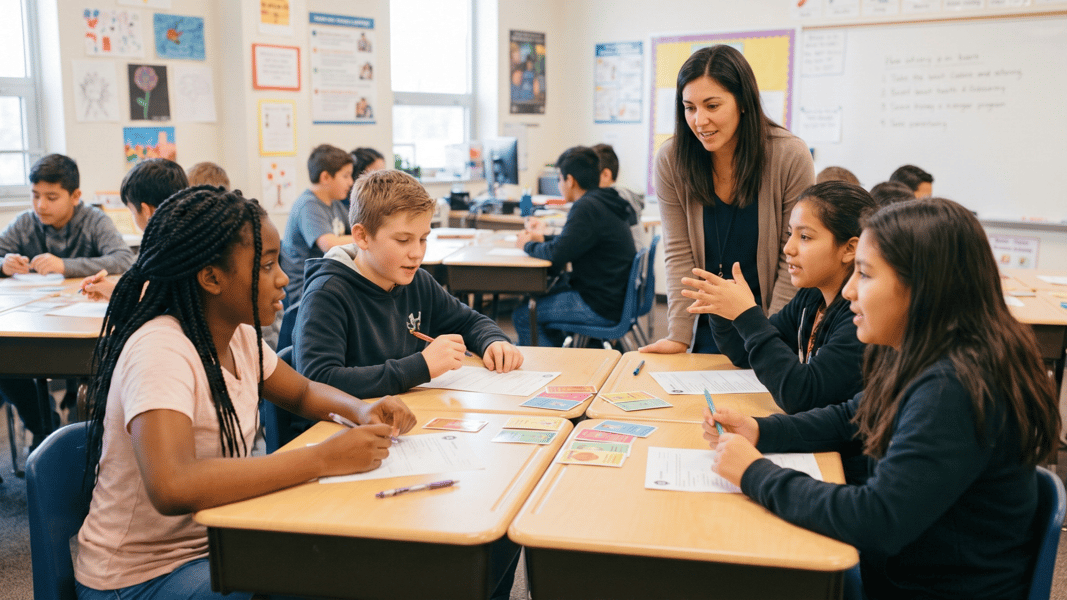
Designed specifically for students in grades 5-9, Understanding Addiction & Mental Health features our Level II full program and standalone lesson. It delivers clear, compassionate, and age-appropriate instruction directly to the classrooms where these critical conversations are needed most.
Guided by Four Core Messages
When talking to young people about addiction, the framing matters just as much as the content. Our new curriculum is built on four fundamental core messages designed to shift perceptions and encourage open dialogue:
- Addiction is a brain condition, not a personal choice. We ground our lessons in neuroscience, showing students how dopamine and the brain's reward system function so they understand addiction as a health issue rather than a moral failure, aligning with research from the National Institute on Drug Abuse (NIDA).
- Both substances and activities can be addictive. Today’s youth face diverse challenges. We help students recognize that compulsive patterns can form around both chemical substances and daily behaviors like gaming or social media.
- Stigma prevents recovery; compassion enables healing. Shame keeps people silent and isolated. By teaching empathy and reframing how we discuss addiction, we help break down barriers to care, supporting SAMHSA's National Prevention Guidelines.
- Resources exist, and asking for support works. No one has to figure this out alone. We provide concrete frameworks so students know exactly how to reach out to Trusted Adults and access help.
Why Start with Grades 5–9?
The research is unambiguous: early adolescence is the single most critical window for prevention.
Between fifth and ninth grade, many young people encounter their first opportunities to experiment with substances, experience heightened academic and social stress, and develop questions about addiction. By reaching students during this developmental pivot point with honest, science-based education, we can change trajectories upstream—equipping them with healthy coping skills before a crisis hits downstream.
Inside the Curriculum: The 4-Lesson Journey
The Level II program guides students through a progressive, hands-on learning experience across four core lessons:
Lesson 1: What is Addiction?
Students begin with an interactive "Myth, Fact, or Not Enough Information?" warm-up. By examining how the brain's reward system responds to both substances and behaviors, they learn to define addiction through science, reinforcing that addiction is a brain condition, not a personal choice.
Lesson 2: Stress, Emotional Triggers & Coping
Students map out their personal stressors and explore the connection between overwhelming emotions and compulsive habits—including digital habits like gaming. They learn and practice the A.C.T. Strategy (Activate, Connect, Think)—a practical framework for managing stress without relying on harmful behaviors.
Lesson 3: Stigma, Support & Help-Seeking
Because stigma prevents recovery and compassion enables healing, this lesson gives students tools to offer nonjudgmental peer support using the Notice, Listen, Connect model. Students learn the importance of healthy boundaries, identify trusted adults in their personal networks, and practice breaking through fear and shame to ask for help.
Lesson 4: Unit Assessment (Station-Based Learning)
Say goodbye to traditional bubble tests. Students demonstrate what they’ve learned through an active, four-station experience: Know the Facts, See the Whole Story, A.C.T. on Stress, and Notice, Listen & Connect.
- Station 1: Know the Facts
- Station 2: See the Whole Story
- Station 3: A.C.T. on Stress
- Station 4: Notice, Listen & Connect
Working independently or in small groups, they put skills into practice through real-world scenario analysis.
Short on time? For schools with limited schedule availability, our Standalone Lesson condenses the program's most vital elements—brain science, myth-busting, stress regulation, and help-seeking frameworks—into a single, high-impact period perfect for advisory blocks or health class guest sessions.
A special thank you to the RB DenUyl Family Foundation for supporting the development of the standalone, one-day addication lesson across all four grade bands.
Designed to Support Educators and Protect Counselor Time
We know classroom time is precious and staff workloads are high. That’s why every Erika’s Lighthouse program is designed for seamless turn-key implementation:
- 100% Free Nationwide: Zero cost for curriculum materials, teacher guides, or student worksheets.
- Fully Pre-Scripted & Plug-and-Play: Designed so any educator, health teacher, or staff member can facilitate with fidelity—no specialized training required.
- Standards-Aligned: Mapped directly to CASEL social-emotional competencies, NHES (National Health Education Standards), ASCA Mindsets & Behaviors, and Erika’s Lighthouse K-12 Learning Standards.
- Protects Clinical Time: Enables school counselors to deliver universal tier-1 instruction efficiently, preserving their clinical time for targeted Tier-2 and Tier-3 student interventions.
What’s Next: The Full K–12 Curriculum Roadmap
This release is just the beginning of a comprehensive K–12 continuum. In the 2027-2028 school year, Erika's Lighthouse will release additional grade bands to complete the full curriculum:
- Introduction Level (Grades K–3): Healthy Choices, Big Feelings & Asking for Help
- Level I (Grades 4–6): Healthy Coping, Habits & Help-Seeking
- Level II (Grades 5-9): Understanding Addiction & Mental Health
- Level III (Grades 8–12): Addiction, Mental Health & Advocacy
Bring These Conversations to Your School
When we show students that resources exist and asking for support works, we give them the confidence to speak up—whether for themselves, a peer, or a family member.
👉 Access the Free Grades 5–9 Addiction Curriculum Today