


How Erika's Lighthouse Programs Align with State Suicide Prevention Mandates and ESSA Tier 2 Requirements
Key Takeaways
- State requirements vary: Schools should review their state's current laws, regulations, and district policies when planning suicide prevention and mental health education.
- Evidence matters: ESSA evidence tiers help schools evaluate the research supporting educational interventions.
- Implementation should be practical: Ready-to-use lessons and staff resources can help schools integrate mental health education into existing schedules.
- Resources are free: Erika's Lighthouse provides its programs and resources at no cost to schools.
- State-specific guidance is available: Explore our state standards alignment resources to learn more about how Erika's Lighthouse programs may support your state's instructional requirements.
School and district leaders are navigating an evolving landscape of requirements for student mental health education, suicide prevention, staff training, and parent notification protocols. At the same time, they need effective, evidence-informed programs that fit within existing schedules and budgets.
How can schools identify resources that support state requirements while building students' mental health knowledge and making it easier for them to seek help?
Erika’s Lighthouse offers free, evidence-informed mental health education programs and resources designed to help schools build supportive environments for students. Its classroom education programs meet legal mandates, align with ESSA Tier 2 standards, and protect teacher and staff capacity.
By exploring state-specific requirements alongside available program resources, school and district leaders can make informed decisions about implementation.
How Do State Suicide Prevention Mandates Impact K–12 Schools?
Across the United States, states have adopted different requirements related to youth suicide prevention, mental health education, school staff training, and prevention policies. The specific requirements, including the grades served, frequency of instruction, personnel who must be trained, and family notification procedures, vary by state.
Examples of state legislation and policies include:
- Illinois: Ann Marie's Law addresses school district suicide prevention policies, annual staff training, and student awareness programs.
- Texas: Senate Bill 11 and related provisions address school-based mental health and suicide prevention strategies across K–12 grade levels.
- California: Legislation including AB 2246 addresses suicide prevention policies addressing high-risk student populations, staff development, and age-appropriate instruction.
- Ohio: The Safety First Act (HB 123) established requirements related to evidence-based instruction in suicide awareness, violence prevention, and social inclusion for grades 6–12.
Explore State-by-State Standards Alignment
As states strengthen or clarify requirements for student mental health education and suicide prevention, school leaders need practical resources to understand the expectations that apply to their schools.
Erika's Lighthouse provides state-specific standards alignment resources to help educators and administrators explore how our free, evidence-informed classroom education programs may support their instructional requirements.
Explore our state standards alignment resources to find information relevant to your state and identify resources that may support your district's implementation efforts.
State Example: Supporting Minnesota's Grades 4–12 Mental Health Requirement
Minnesota provides an example of how state-specific requirements can shape district planning. Minnesota Statute 120B.21 addresses school district requirements related to mental health education for students in grades 4-12.
Erika's Lighthouse offers age-appropriate classroom programs, scripted lessons, and implementation resources that can help schools plan mental health and suicide prevention education. Schools should review the applicable state requirements and determine how these resources fit their local policies and instructional plans.
How Can Erika’s Lighthouse Fulfill State Suicide Prevention Requirements?
Erika’s Lighthouse provides resources that can help schools build a coordinated approach to mental health education and prevention across four areas:
1. Universal Student Education (K–12)
State requirements may include age-appropriate student instruction on recognizing depression, identifying warning signs, and seeking help from trusted adults.
Erika's Lighthouse Classroom Education Programs offer structured lessons for elementary, middle school, and high school classrooms. The programs use videos, guided discussion, and educator materials to help students build mental health knowledge, challenge stigma, and learn how to seek support.
2. Staff Training
Most state mandates require annual professional development for certified and non-certified school personnel.
The Erika's Lighthouse Staff Training on Adolescent Depression & Suicide provides a self-paced, bite-sized training listed on the Suicide Prevention Resource Center (SPRC) Best Practices Registry. Staff learn to recognize warning signs, foster approachable "trusted adult" relationships, and execute warm handoffs to school social workers and counselors.
3. Clear Referral & Crisis Protocols
State legislation often dictates that schools establish clear pathways for handling at-risk youth. Erika’s Lighthouse assists administrators by providing model policy templates and self-referral mechanisms that link classroom education directly to studensupservices.
4. Family Notification & Engagement
Legislative guidelines emphasize partnership with parents and guardians. Erika's Lighthouse supplies ready-to-use Family Engagement Resources, including bilingual (English/Spanish) parent awareness letters, family conversation guides, and home workshops.
Schools can use these materials as part of their broader family engagement efforts and should follow any specific notification or communication requirements that apply to their state or district.
What Are ESSA Evidence Tiers, and Why Do They Matter?
The Every Student Succeeds Act (ESSA) provides a framework for evaluating the evidence supporting educational interventions. Its evidence tiers describe different levels of research support.
The four commonly referenced ESSA evidence levels are:
TIER 1: Strong Evidence ──► Supported by at least one well-designed and well-implemented experimental study.
TIER 2: Moderate Evidence ──► Supported by at least one well-designed and well-implemented quasi-experimental design studies.
TIER 3: Promising Evidence ──► Supported by at least one well-designed and well-implemented correlational study with statistical controls.
TIER 4: Demonstrates Rationale──► Supported by a rationale based on high-quality research or a well-supported logic model, with ongoing efforts to study effects.
Evidence tiers can help school and district leaders assess research when selecting interventions. The evidence tier a district needs depends on the particular program, funding stream, or applicable federal, state, or local requirements. ESSA evidence tiers should not be treated as a universal requirement.
For more information, consult the U.S. Department of Education's ESSA Evidence guidance.
How Do Erika’s Lighthouse Programs Align With ESSA Tier 2 Evidence Standards?
Erika’s Lighthouse classroom education programs meet the criteria for ESSA Tier 2 (Moderate Evidence) based on quasi-experimental evaluation research demonstrating significant, positive impacts on student help-seeking behaviors, mental health literacy, and stigma reduction.
Key Research Findings
National evaluation studies published in the Erika's Lighthouse Impact Report analyze pre- and post-program student survey data, demonstrating that universal MTSS Tier-1 programs achieve statistically significant gains:
- Increased Help-Seeking Comfort: Student comfort in approaching a trusted adult at school about mental health concerns increased significantly following program participation.
- Enhanced Knowledge & Stigma Reduction: Students demonstrated measurable gains in identifying clinical depression warning signs and rejecting common mental health stigmas.
- Identification of Prospective Support: Participation helped students identify specific adults within the school building they could turn to during a crisis.
Because the research utilizes rigorous quasi-experimental design across diverse public, private, urban, suburban, and rural school settings, district leaders can confidently cite Erika's Lighthouse to fulfill ESSA compliance requirements.
Side-by-Side: Legislative & Federal Compliance Alignment
This summary matrix demonstrates how Erika's Lighthouse satisfies state mandates and federal funding requirements:
| Compliance Requirement | State Mandate Alignment | ESSA Tier 2 Alignment | Erika's Lighthouse Deliverable |
| Student Instruction | Fulfills mandatory suicide prevention & mental health education laws | Meets evidence standards for Tier-1 universal classroom interventions | Level I-III Programs are listed on the SPRC Best Practices Registry. Turnkey K–12 classroom modules (video-based, fully scripted) |
| Staff Training | Satisfies annual gatekeeper training mandates for K–12 personnel | Provides professional development supported by evaluation research | SPRC-listed self-paced staff training modules |
| Program Evaluation | Meets state reporting needs for evidence-informed practices | Backed by quasi-experimental pre/post survey research studies | Erika's Lighthouse Data Center survey tools |
| Equity & Access | Fulfills state equity standards for bilingual & diverse populations | Satisfies federal requirements for accessible Tier-1 programming | 100% free resources fully available in both English and Spanish and accessible for individuals with visual disabilities |
A Practical Checklist for District Leaders
As you review your district's approach to student mental health education and suicide prevention, consider the following steps:
| Focus Area | |
| Review current requirements | Consult state statutes, education department guidance, and district policies. |
| Identify implementation gaps | Determine which grade levels, staff groups, or school procedures need additional attention. |
| Evaluate available programs | Review lesson content, grade-level coverage, staff resources, and research evidence. |
| Plan implementation | Identify where instruction and training will fit within the existing schedules and who will coordinate delivery. |
| Review student support procedures | Ensure staff know how to connect students with appropriate school support and follow established protocols. |
| Document progress | Use appropriate implementation records and evaluation tools to monitor delivery and inform future planning. |
Explore Free Resources for Your District
Fulfilling state suicide prevention mandates and ESSA Tier 2 requirements does not require expensive vendor contracts or burdensome administrative setup. Erika’s Lighthouse provides all classroom programs, staff trainings, family tools, and evaluation metrics 100% free of charge.
Whether your district is responding to a new state requirement or strengthening its existing approach, our resources can help you explore options for age-appropriate instruction and implementation.
- Access free programs: Create a free account to explore available classroom programs and resources.
- Explore state alignment: Visit our States Mandates & Recommendations page to find resources relevant to your state.
- Learn about the evidence: Review Erika's Lighthouse research and impact data to understand program outcomes.
- Connect with our team: Contact us to discuss your school or district's needs.
FAQs
Frequently Asked Questions
Are Erika’s Lighthouse programs free for public school districts?
Yes. All classroom curricula, staff training tools, family engagement materials, and data collection systems are 100% free to all K–12 schools.
How does Erika's Lighthouse support state reporting requirements?
The Erika’s Lighthouse Data Center allows districts to track implementation metrics, collect student pre- and post-program evaluation data, and generate reports demonstrating compliance with state mandates and ESSA standards.
Does Erika’s Lighthouse satisfy gatekeeper training requirements for non-instructional staff?
Yes. The self-paced Staff Training on Adolescent Depression & Suicide modules are designed for all school personnel—including teachers, administrators, paraprofessionals, coaches, bus drivers, and support staff.
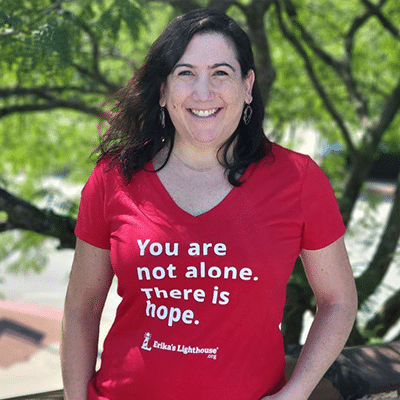
Ilana Sherman, MPH
Director of EducationIlana joined Erika’s Lighthouse in September 2019 as Director of Education. She has a Masters Degree in Public Health from the University of Illinois at Chicago. Ilana brings with ...
Learn more about Ilana...