

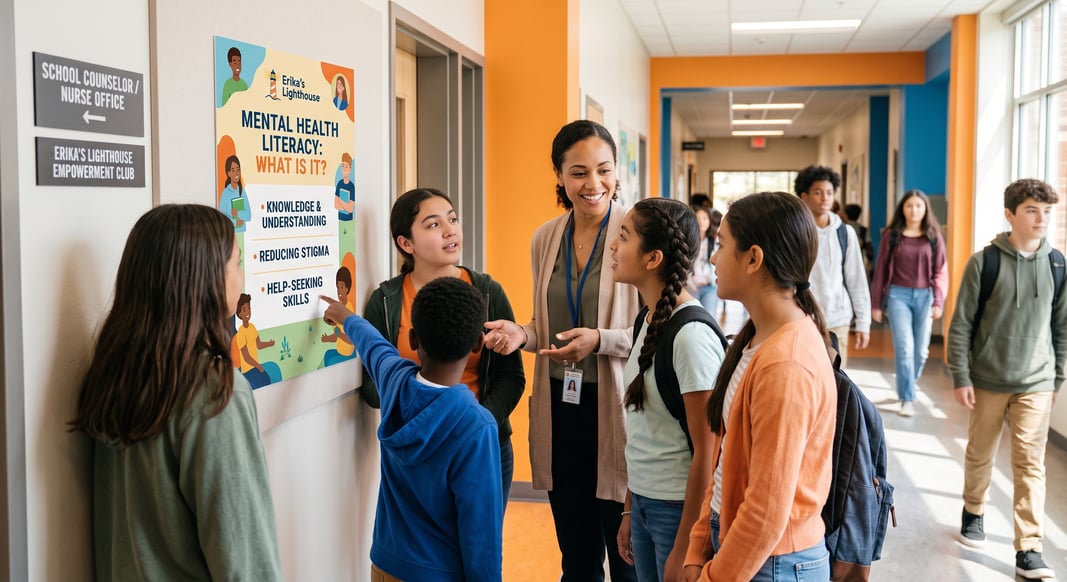
What Is Mental Health Literacy for Students? A Guide for K–12 Schools
Key Takeaways
- Mental health literacy is more than awareness. Students need knowledge, understanding, and practical skills they can use to support their mental health and seek help.
- Students need to know what to look for. Mental health literacy helps students recognize signs that they or someone else may be struggling.
- Help-seeking is a core skill. Students need to know when to ask for help, who they can turn to, and what to do next.
- Schools build literacy through education. Developmentally appropriate mental health education can help reduce stigma and strengthen students’ ability to seek support.
- It works best as part of a broader approach. Classroom education is most effective when students also have access to supportive adults, clear pathways to help, and engaged families and communities.
What Is Mental Health Literacy for Students?
Mental health literacy is the knowledge, understanding, and skills students need to recognize mental health challenges, reduce stigma, support themselves and others, and know when and how to seek help.
For schools, mental health literacy is about more than teaching students what depression or anxiety means. It is about helping students recognize when something may be wrong, understand that mental health is part of overall health, know how to respond to a concern, and feel prepared to seek support.
The CDC defines mental health literacy as having knowledge and understanding of mental health concepts, along with the skills to seek help when needed. The CDC recommends that school based mental health education address concepts such as symptoms, treatment opportunities and barriers, reducing stigma, and communicating with trusted adults.
For K–12 schools, that makes mental health literacy an important part of prevention and early intervention.
Why Does Mental Health Literacy Matter in K–12 Schools?
A student may know that depression is a mental health condition but still not recognize when changes in their own mood, behavior, or functioning may be a reason to talk with an adult.
Another student may recognize that a friend is struggling but not know what to say or when to involve an adult.
Mental health literacy helps bridge that gap between knowing about mental health and knowing what to do.
The CDC reports that quality school-based mental health education can improve mental health knowledge and attitudes, reduce stigma, and increase help-seeking behaviors. It also recommends that mental health education be medically accurate and developmentally appropriate.
Erika’s Lighthouse research points in a similar direction. A peer-reviewed evaluation of its high school program found statistically significant improvements in students’ depression knowledge and willingness to approach trusted adults at school when experiencing mental health distress.
A 2025 systematic review of 53 adolescent suicide-prevention studies also included Erika’s Lighthouse among 41 programs reviewed and found positive findings across outcomes including knowledge, attitudes, and help-seeking, while examining substantial variation among programs and study designs.
Mental health literacy does not mean asking students to diagnose themselves or their friends.
The goal is recognition, understanding, and knowing when and how to seek appropriate support.
What Should Students Know About Mental Health?
Mental health literacy should develop over time. What students learn in elementary school will look different from what is appropriate for middle and high school students, but several concepts can form the foundation.
Everyone Has Mental Health
Students can learn that mental health is part of overall health and that everyone has mental health—not only people who have a mental illness.
This helps make mental health a normal topic of conversation rather than something that should only be discussed when there is a crisis.
Mental Health Can Change
Students experience many emotions and mental health states throughout their lives.
Developmentally appropriate education can help students understand the difference between everyday emotional experiences and changes that are persistent, overwhelming, or interfering with daily life.
Younger students may begin with identifying emotions, coping strategies, and asking a trusted adult for help. Older students can build on that foundation by learning about depression, suicide prevention, stigma, and accessing support.
Mental Health Challenges Have Signs and Symptoms
Students need accurate, age-appropriate information about what mental health challenges can look like.
For example, students may learn about changes associated with depression, such as persistent sadness or irritability, loss of interest, changes in sleep or appetite, difficulty concentrating, or feelings of worthlessness.
The purpose is not to teach students to diagnose themselves or someone else.
Instead, students can learn that noticing significant or persistent changes is a reason to talk with a trusted adult.
Mental Health Challenges Are Treatable
Students may be less likely to seek help when they believe mental health challenges are something a person simply has to handle alone.
Mental health education can help students understand that mental health challenges are common and that people can benefit from support, treatment, coping strategies, and caring relationships.
It can also reinforce an important message:
Asking for help is a healthy skill—not a sign of weakness.
Help-Seeking Is a Skill
Students need more than the instruction to “talk to someone.”
They can learn:
• When it may be time to ask for help
• Who they can approach
• What they can say
• What to do if their first choice is unavailable
• How to support a friend without taking responsibility for solving the problem
• When an adult or mental health professional needs to become involved
The CDC specifically identifies help-seeking as an important skill within mental health education.
For more on putting these skills into practice, see 7 Ways Schools Can Encourage Student Help-Seeking for Mental Health.
What Skills Does Mental Health Literacy Teach?
Strong mental health education moves students from knowing to doing.
| Skill | What Students Can Learn |
| Recognizing |
Identify signs that they or someone else may be struggling. |
| Understanding | Understand basic mental health concepts and when a concern may require support |
| Communicating | Talk about mental health using appropriate, non-stigmatizing language |
| Seeking help |
Know when, how, and from whom to ask for support |
| Supporting peers | Listen, encourage help-seeking, and involve a trusted adult when appropriate |
| Reducing stigma | Challenge myths and understand that mental health is part of overall health |
| Accessing resources | Know where to find reliable information and appropriate support |
This distinction between knowledge and skills matters.
How Can Schools Build Mental Health Literacy?
Schools can build mental health literacy through universal education and by connecting what students learn in the classroom to the broader school environment.
Provide Universal Mental Health Education
Universal education gives every student access to foundational information and skills—not only students who have already been identified as needing additional support.
The CDC identifies classroom-based mental health education as one way schools can increase students’ mental health literacy. It recommends medically accurate, developmentally appropriate content that addresses mental health concepts, stigma, communication, and help-seeking.
Erika’s Lighthouse provides free K–12 classroom mental health education designed to build mental health literacy, reduce stigma, and encourage help-seeking.
Use Age-Appropriate Content
Mental health education should reflect students’ developmental levels.
Schools can consider:
• Age and developmental stage
• Reading level and accessibility
• Cultural and community context
• Age-appropriate examples and language
• The types of mental health concerns students may encounter
• Appropriate pathways for seeking help
A strong program should give students information they can understand and skills they can actually use.
Give Students Opportunities to Practice
Mental health literacy should not end when a lesson ends.
Students can practice:
• Identifying signs of concern
• Responding to realistic scenarios
• Finding appropriate sources of help
• Using non-stigmatizing language
• Supporting a friend appropriately
• Identifying what they would do if they were worried about themselves or someone else Practice helps turn information into usable skills.
Connect Education to Real Support
Students should know what to do if a lesson makes them realize they or someone they know may need help.
Schools can make support pathways clear by identifying counselors, social workers, teachers, nurses, coaches, administrators, community providers, and other appropriate sources of support.
This is where classroom education and school systems need to work together.
Create a Common Language
A schoolwide approach can help students and adults use consistent language when discussing mental health.
That might include shared language around:
• Mental health
• Stigma
• Depression
• Help-seeking
• Trusted adults
• Warning signs
• Coping
• School and community resources
A common vocabulary can make it easier for students to understand and act on messages they hear across different school settings.
For more on evaluating the curriculum itself, see How to Choose a School Mental Health Curriculum.
Does Mental Health Education Improve Help-Seeking?
Research suggests that school-based mental health education can contribute to improved help seeking, although outcomes vary by program, implementation, population, and study design.
Erika’s Lighthouse’s National Report: Youth Help-Seeking Around Mental Health analyzed pre- and post-program survey data from more than 33,000 students across 515 U.S. schools. After participating in Erika’s Lighthouse classroom programming, the percentage of students who reported feeling comfortable talking with a trusted adult at school about their mental health increased from 38% to 50%.
The report also found that the percentage of students reporting discomfort talking with a trusted adult decreased from 21% to 16%.
The 2025 systematic review examined 53 studies involving 41 adolescent suicide-prevention programs. Help-seeking was measured in 67% of the studies and knowledge and awareness in 94%. The review reported positive findings among studies measuring outcomes such as help seeking, knowledge, attitudes, and coping.
These findings support an important distinction:
Mental health education can give students the knowledge and skills to recognize concerns and understand how to seek support. Schools then need accessible systems and caring adults to help students take the next step.
What Should Schools Look for in a Mental Health Education Program?
To ensure a program goes beyond basic awareness and delivers lasting impact, school leaders and educators can evaluate potential curricula using the following criteria:
- Is it evidence-informed? What research or evaluation supports the program?
- Is it developmentally appropriate? Does the content match students’ ages and abilities?
- Does it teach skills? Do students learn what to do—not just what mental health means?
- Is it medically accurate? Who develops and reviews the content?
- Does it address stigma? Does it help students challenge misconceptions?
- Does it teach help-seeking? Do students learn when and how to reach out?
- Is it inclusive? Can students see their experiences and identities reflected?
- Can educators implement it? Are lessons practical and supported?
- Does it connect to the broader school system? Are families, staff, and student support pathways considered?
- Can schools measure outcomes? Is there a way to understand whether students are learning?
These questions can help schools distinguish between a program that simply provides information and one designed to build lasting mental health literacy.
How Can Schools Measure Mental Health Literacy?
Schools can use multiple types of information to understand whether students are developing mental health literacy.
Depending on the program and goals, schools might measure:
• Knowledge of mental health concepts
• Ability to recognize signs and symptoms
• Understanding of stigma
• Confidence discussing mental health
• Knowledge of available resources
• Willingness to seek help
• Ability to identify appropriate sources of support
• Student perceptions of school mental health culture
The goal is not simply to know whether students completed a lesson.
A more useful question is: What did students learn, and are they more prepared to use those skills?
Erika’s Lighthouse provides a Data Center with outcome data and evaluation resources that can help schools understand the impact of school mental health programming.
A Quick Mental Health Literacy Framework
Schools can use this framework when evaluating their current approach:
| Area | Ask Your School | Look For | |
|
Knowledge |
Do students understand basic mental health concepts? | Developmentally appropriate education | |
| Recognition | Can students recognize signs that someone may be struggling? | Lessons, scenarios, skill-building | |
| Stigma | Can students challenge common misconceptions? | Non-stigmatizing language and discussion | |
| Help-Seeking | Do students know when and how to ask for help? | Clear pathways and practice | |
| Peer support | Do students know how to support a friend appropriately? | Peer-support skills and boundaries | |
| Access | Do students know where to find reliable information and support? |
|
|
| Measurement | Does the school know what students are learning? | Surveys, assessments, program evaluation |
Build Mental Health Literacy at Your School
Mental health literacy gives students something they can use beyond a single lesson: the knowledge and skills to recognize when something may be wrong, talk about mental health without stigma, support a peer appropriately, and know when to ask for help.
But students should not have to figure it out alone.
A comprehensive school approach connects classroom education with supportive adults, student leadership, family engagement, staff preparation, and clear pathways to support.
Erika’s Lighthouse provides free K–12 mental health programs designed to build mental health literacy and help-seeking skills. Its programs include classroom education, student-led Empowerment Clubs, family engagement, and staff resources.
Schools can explore Erika’s Lighthouse programs and resources to find free, evidence informed tools for building mental health literacy across their school community.
For more information about the research behind Erika’s Lighthouse programs, visit The Evidence of Impact.
FAQs
Frequently Asked Questions
What is mental health literacy for students?
Mental health literacy is the knowledge, understanding, and skills students need to recognize mental health challenges, reduce stigma, support themselves and others, and know when and how to seek help.
Why is mental health literacy important in schools?
Mental health literacy can help students recognize mental health concerns, understand stigma, develop help-seeking skills, and know where to find appropriate support. Schools are an important setting for universal mental health education because they can reach students before a concern becomes a crisis.
What should students learn about mental health?
Students should learn about mental health and well-being, signs and symptoms of mental health challenges, stigma, healthy coping, how to support peers appropriately, and when and how to seek help from trusted adults and professionals.
At what age should students learn about mental health?
Mental health education can begin in age-appropriate ways in elementary school and become more specific as students get older. Younger students may focus on emotions, coping, healthy habits, and asking trusted adults for help. Older students can learn more about other mental health disorders, suicide prevention, stigma, and accessing support.
Does mental health literacy reduce stigma?
Quality mental health education can help reduce stigma by providing accurate information, challenging misconceptions, and creating opportunities for respectful conversations. The CDC identifies reduced stigma as one potential benefit of quality school-based mental health education.
Does mental health literacy improve help-seeking?
Mental health literacy can support help-seeking by helping students recognize when they may need support and understand how to access it. In Erika’s Lighthouse’s national outcome analysis, student comfort talking with a trusted adult at school about mental health increased from 38% to 50% following classroom programming.
What is the difference between mental health literacy and mental health awareness?
Mental health awareness generally refers to recognizing that mental health is important and understanding basic information about it. Mental health literacy goes further by including knowledge, understanding, and practical skills—particularly the ability to recognize concerns and seek appropriate help.
Who can teach mental health literacy in schools?
Depending on the school and program, mental health education may be delivered by classroom teachers, health educators, school counselors, social workers, or other trained school professionals. The CDC notes that classroom teachers and school counselors can deliver mental health education when supported by appropriate curriculum and training.
Katie Conklin
Vice President of ProgramsKatie joined Erika’s Lighthouse in August 2021. She has a Master’s degree in Human Services and Counseling from DePaul University. Katie has over 20 years of experience working in ...
Learn more about Katie...