


What We Learned Traveling to Advance Youth Mental Health Education
Key Takeaways
- Attending national conferences helps Erika's Lighthouse refine internal operations to deliver our free, high-quality curriculum more effectively.
- Collaborating with health plans and technology leaders expands the reach of our tier-one, skills-based program.
- Learning from the broader behavioral health sector directly supports our Impact 2030 goal to reach over 2.5 million students annually.
Over the past month, I have traveled across the country to represent Erika's Lighthouse. My goal was to observe new developments in mental health technology, share our programs, and learn how we can better support school districts. We believe every student should have the knowledge and tools they need to care for their mental health. Engaging directly with other professionals helps us deliver on that mission. Here are my observations from these recent events.
How Can Technology Improve Our Operations?
My first stop was HubSpot's Annual Marketing and Tech Conference, Unbound, in Boston. Operating a non-profit requires organized data, clear communication, and efficient processes. I attended this conference to observe how we can improve our internal and external operations.
We provide our depression education and suicide prevention curriculum to school districts at zero cost. Improving our marketing and technology operations ensures that busy educators can access every program on our website in just a few clicks.
What Are the Latest Developments in Behavioral Health?
Next, I traveled to Nashville for the Behavioral Health Tech Conference at the Gaylord Opryland Resort & Convention Center. The event featured distinct session tracks, including "Youth & Young Adults," "Scaling Access," and "AI & High Tech."
I attended to learn about the current development and approach within the behavioral health space. Understanding how evidence-based care and digital tools scale access helps us contextualize our own skills-based curriculum. It ensures our peer-to-peer approach remains relevant and credible with students. It was also the impetus for an upcoming white paper on how technology in schools must be grounded in in-person, layered human connection.
Why Are Health Collaborations Important?
In San Antonio, we hosted an exhibit booth at the Medicaid Health Plans of America (MHPA) Annual Conference . We used this time to promote health collaborations and represent the work of Erika's Lighthouse.
Many organizations are looking for practical, upstream solutions to address the youth mental health crisis. By exhibiting at MHPA26, we shared how our Classroom Education Programs equip students with the skills to recognize the signs and symptoms of depression in themselves and their peers. Building relationships with health plans allows us to align our prevention models with broader healthcare initiatives.
How Do We Support Regional Youth Mental Health?
My final trip was to Jackson, Wyoming, for the Intermountain West Youth Mental Health Symposium hosted by the Ortus Foundation. This symposium provided a venue to discuss the specific mental health challenges facing youth in that region.
Our curriculum is designed to easily flex to meet the needs of individual districts, schools, and classrooms. Participating in regional symposiums helps us understand the distinct geographic needs of school communities so we can offer relevant, high-touch support to educators through our Policy & Staff Training resources.
Advancing Toward Impact 2030
Attending these four conferences reinforces our commitment to providing a tier-one, skills-based depression education and suicide prevention curriculum. Engaging directly with technology professionals, health plan administrators, and regional advocates ensures our operations and educational materials remain relevant for school districts.
As we advance toward our Impact 2030 goal to reach over 2.5 million students annually, we will continue to rely on these cross-sector collaborations. We believe every student should have the knowledge and tools they need to care for their mental health. By refining our Four Pillar programs—classroom education, empowerment clubs, family engagement, and policy and staff training—we ensure educators can always access these resources at zero cost to support their communities.
FAQs
How does Erika's Lighthouse contribute to mental health thought leadership?
- We operate at the forefront of depression education and suicide prevention curriculum based on decades of experience.
- We are establishing a research center and partnering with universities to analyze youth mental health data and demonstrate program effectiveness.
Why is attending technology and health conferences important for our mission?
- Participating in technology-focused events helps us prepare our operations for an AI-powered future.
- Learning from industry experts ensures our educational content remains relevant, authentic, and credible for students.
Why do we prioritize collaborations with health plans and external organizations?
- Addressing the youth mental health crisis requires collective action across different sectors.
- Health plan collaborations help integrate upstream school prevention into broader community healthcare networks.
- Building external relationships supports our strategic goal to impact over 2.5 million students annually by 2030.
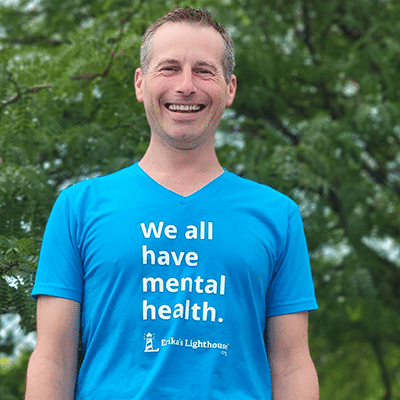
Brandon Combs, MNA
Executive DirectorBrandon Combs is a forward-thinking nonprofit executive serving as the Executive Director of Erika’s Lighthouse. Driven by a commitment to student well-being, he leads the organiza...
Learn more about Brandon...