

Urban District Evaluation: Erika’s Lighthouse Programs Across Grades 5–11
A field evaluation presented at the 2025 Advancing School Mental Health Conference assessing the impact of Erika’s Lighthouse single-lesson interventions on over 4,100 elementary, middle, and high school students in a large urban public school district.

Key Takeaways
- Large-Scale Urban Evaluation: Evaluated 4,198 students across 5th through 11th grades in the Newark Board of Education district across three developmentally tailored program levels.
- Statistically Significant Knowledge & Belief Gains: Repeated-measures MANOVA testing revealed significant improvements across all grade levels in depression literacy, self-care awareness, and suicide referral knowledge.
- School as a Safe Space for Mental Health: Across all three age groups, students reported a dramatic post-intervention increase in feeling comfortable talking about mental health inside their school building.
- Expanded Network of Trusted Adults: Students demonstrated increased identification of teachers, social workers, and coaches as trusted adults they can approach when in distress.
- High-Impact, Time-Efficient Delivery: Confirms that single 30–50 minute developmentally tailored classroom lessons produce immediate, measurable shifts in student norms and help-seeking attitudes.
Why This Matters
Urban school districts often serve diverse student populations while facing significant resource and staffing constraints. Demonstrating that universal mental health education works across elementary, middle, and high school levels provides district leaders with a scalable model for primary prevention.
This evaluation highlights three key pillars of the Erika's Lighthouse framework in action:
- Developmental Continuum (Grades 5–11): Shows that universal suicide prevention and mental health education can be effectively tailored across age groups—from foundational wellness in upper elementary (We All Have Mental Health) to clinical depression literacy in middle school (Depression Awareness) and suicide prevention in high school (Depression Education & Suicide Awareness).
- Whole-School Responsibility: By highlighting noticeable gains in student trust toward coaches (up to 54.3% in high school) and teachers (up to 68.1%), the intervention distributes the supportive community role beyond social workers alone, reducing overall burden on clinical staff.
- Efficiency in the Classroom: Proves that a single 30- to 50-minute lesson fits easily into standard school schedules while delivering statistically significant, immediate improvements in student mental health norms.
Erika's Lighthouse Works
The evaluation utilized a single-group pretest-posttest design across 4,198 students (1,884 elementary, 1,671 middle school, and 643 high school students). Changes were evaluated using 4-point Likert scale surveys and analyzed via repeated-measures:
| Survey Measure & Question Area | Grades 5 & 6 (Elem) | Grades 7 & 8 (MS) | Grades 9 & 11 (HS) |
| "People should talk about mental health problems" | 3.07 ➔ 3.22 | 3.19 ➔ 3.36 | 3.31 ➔ 3.42 |
| "I can identify the signs and symptoms of depression" | N/A | 2.90 ➔ 3.15 | 3.06 ➔ 3.25 |
| "I know how to refer a friend who is talking about suicide" | N/A | 3.06 ➔ 3.21 | 3.05 ➔ 3.23 |
| Comfort Talking About Mental Health at School (% Endorsed) | 35.1% ➔ 47.3% | 42.3% ➔ 51.4% | 35.0% ➔ 41.3% |
Shift in Trusted Adult Endorsement
| Trusted Adult Category | Grades 5 & 6 Pre ➔ Post | Grades 7 & 8 Pre ➔ Post | Grades 9 & 11 Pre ➔ Post |
| Teachers | 66.8% ➔ 67.9% | 62.6% ➔ 67.7% | 64.2% ➔ 68.1% |
| Social Workers | 42.8% ➔ 49.6% | 57.3% ➔ 61.2% | 68.6% ➔ 67.8% |
| Coaches | 25.4% ➔ 31.2% | 31.8% ➔ 37.2% | 46.8% ➔ 54.3% |
The Authors
This evaluation was conducted as a research partnership between scholars at Rutgers University (Graduate School of Applied and Professional Psychology) and district leaders from the Newark Board of Education.
| Investigator | Role & Affiliation |
| Narmada Paul, MA | Lead Author — Rutgers University (GSAPP) |
| Natalie Brousseau | Co-Author — Rutgers University (GSAPP) |
| Samantha Santiago | Co-Author — Rutgers University (GSAPP) |
| Samantha Parreiral | Co-Author — Newark Board of Education |
| Emily Graybill, PhD | Co-Author — Rutgers University (GSAPP) |
Access the Paper
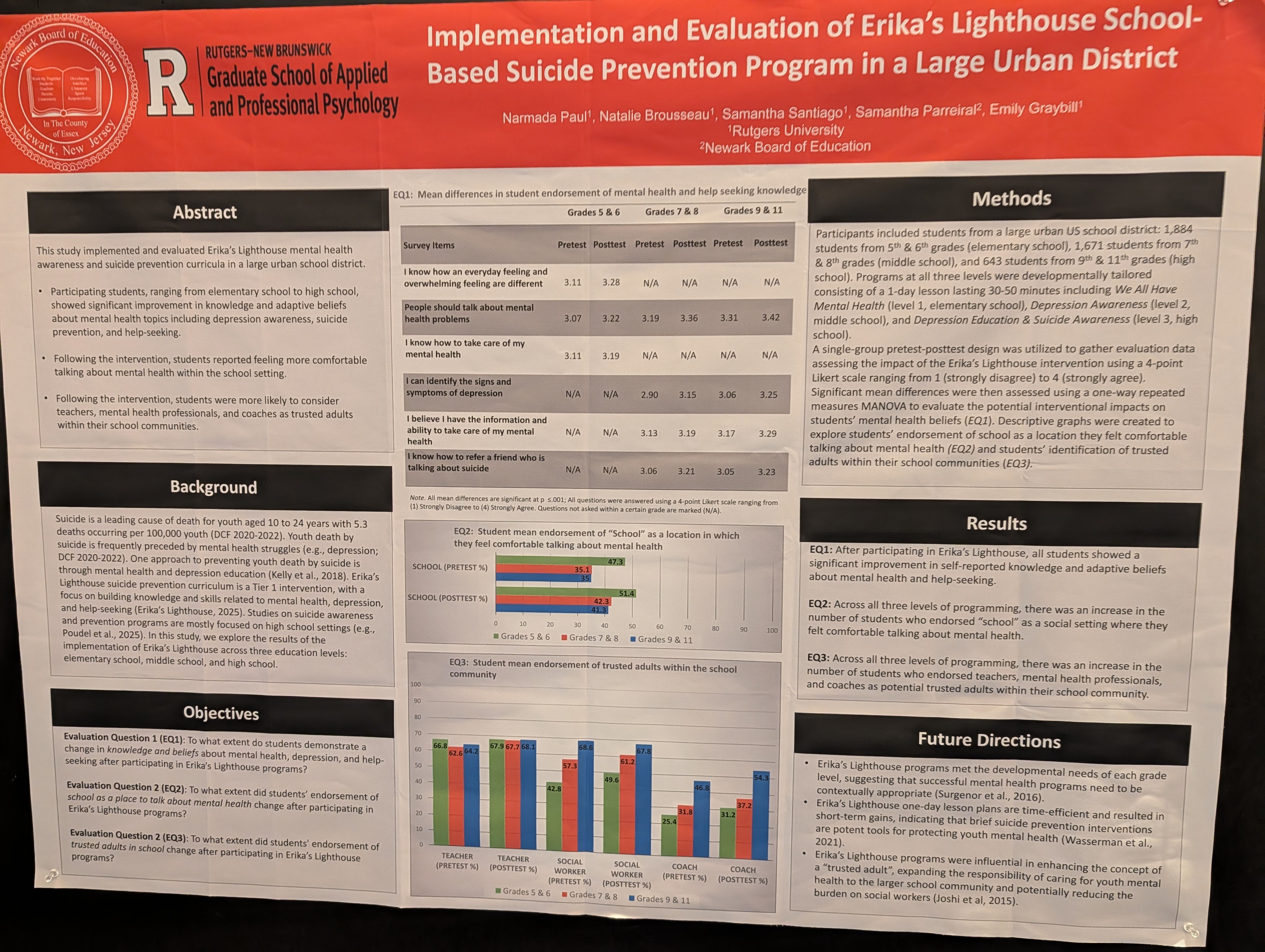
Citation: Paul, N., Brousseau, N., Santiago, S., Parreiral, S., & Graybill, E. (2025, December 2–4). Implementation and evaluation of Erika’s Lighthouse school-based suicide prevention program in a large urban district [Poster presentation]. Advancing School Mental Health Conference, Orlando, FL, United States.
Access FREE Curriculum & Resources
Create a free Resource Portal account to gain instant access to all resources. You can start implementing in your school today.