

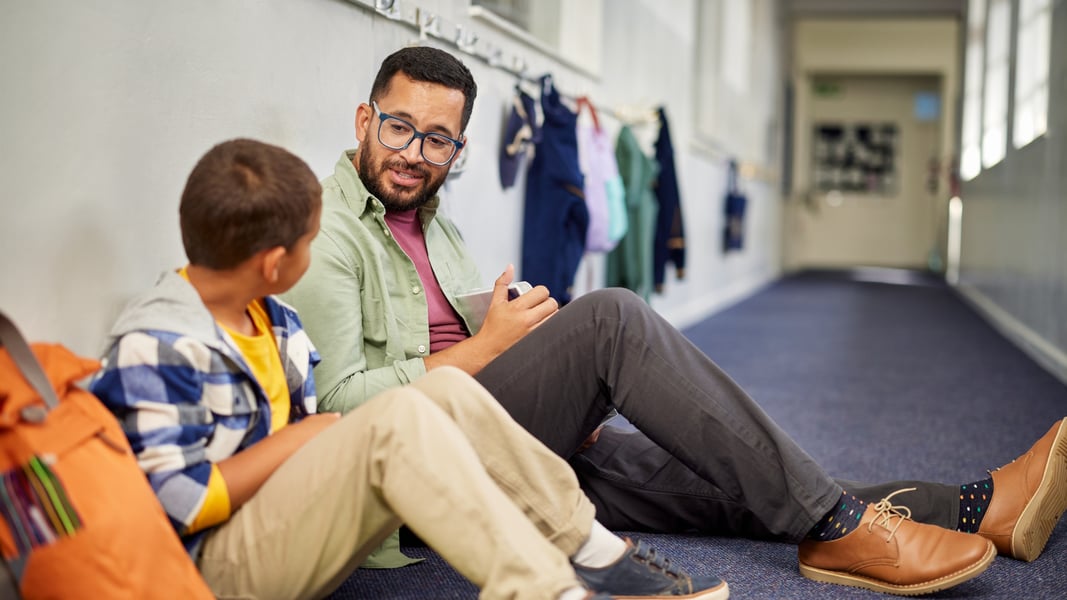
How to Help School Staff Become Trusted Adults for Students
Key Takeaways
- Knowing isn't the same as trusting. 93% of students identify a teacher as a potential trusted adult, but only 50% feel comfortable talking with a trusted adult at school about their mental health.
- Education alone isn't enough. Classroom Education increased students' comfort with help-seeking, but did not increase the percentage who reported having a trusted adult
- Trust takes time. Staff training and mental health education work best as part of an ongoing, schoolwide approach.
- Everyone has a role. Trusted adult relationships involve staff, students, families, and the broader school community.
For many students, having a trusted adult at school can make it easier to ask for help when they are struggling with their mental health.
But being a trusted adult is about more than simply being approachable. Students need to know who they can turn to, feel comfortable starting a difficult conversation, and trust that the adult will listen and help them find the right support.
Research from Erika’s Lighthouse highlights an important challenge: students often know which adults could be trusted, but they don’t always feel comfortable talking with those adults about their mental health. The good news is that schools can take concrete steps to make those conversations easier.
What Is a Trusted Adult?
A trusted adult is someone a young person considers reliable, dependable, trustworthy, and able to help. That person might be a parent, teacher, counselor, coach, social worker, school nurse, administrator, or another caring adult in the student’s life.
Students don’t all need the same trusted adult. One student may feel most comfortable talking with a teacher; another may connect with a coach, counselor, or school social worker. Creating a network of supportive adults gives students more opportunities to find someone they feel comfortable approaching.
The Trusted Adult Gap: What Erika’s Lighthouse Research Shows
The Erika’s Lighthouse Youth Help-Seeking Around Mental Health report provides important insight into how students view trusted adults and help-seeking.
The study analyzed 18,077 pre-program surveys and 15,271 post-program surveys from 515 schools across the United States. Students in grades 5–12 participated, representing public, private, and charter schools as well as urban, suburban, and rural communities.
The findings reveal a significant gap: 93% of students identified a teacher as someone who could be a trusted adult, yet only 50% said they would be comfortable talking with a trusted adult at school about their mental health.
That is a 42-percentage-point gap. Simply having caring adults in a school isn’t enough. Schools also need to create a culture in which students feel safe and comfortable approaching those adults.
What Does Independent Research Say?
This isn’t unique to one program or organization. A 2025 systematic review of 53 studies involving 41 adolescent suicide-prevention programs found that school-based programs can improve outcomes such as help-seeking, knowledge, attitudes, and coping. The review also found substantial variation among programs and outcomes, making it difficult to draw conclusions about overall effectiveness.
One program highlighted in the review, Source of Strength, specifically incorporates trusted adults and help-seeking from adults.
Read the 2025 systematic review on PubMed.
The broader lesson is important for schools: there is no single program or training that should be expected to address every aspect of youth mental health. Comprehensive and collaborative approaches matter.
There is also encouraging evidence from Erika’s Lighthouse: after participating in its Classroom Education programs, student comfort in talking to a trusted adult at school rose from 38% to 50%, while the number of students who felt uncomfortable dropped from 21% down to 16%.
What Does That Tell Schools?
Mental health education can help students develop the knowledge and confidence to seek support. But education alone cannot create every trusted adult relationship.
The Erika’s Lighthouse report found that the percentage of students reporting that they had no trusted adult remained essentially unchanged after the short-term program—5.24% before the program compared with 5.23% afterward. The report concludes that building trusted adult relationships requires a more comprehensive and deliberate approach to school and community connectedness.
That distinction is critical. Schools shouldn’t think of trusted adult relationships as something they can create with a single lesson or training session. They are built over time.
7 Ways Schools Can Help Staff Become Trusted Adults
1. Build Relationships Before Students Need Help
A student is more likely to approach an adult they already know, trust, and feel connected to. Relationship-building can't begin only when a student is in crisis.
Teachers and other school professionals can build trust through everyday interactions:
● Learn students' names and interests.
● Check in with students regularly.
● Listen without immediately trying to solve the problem.
● Follow through on commitments.
● Notice when a student's behavior or mood changes.
● Create opportunities for students to talk without judgment.
● Let students know that asking for help is a strength, not a weakness.
2. Normalize Mental Health Conversations Throughout the Year
Students shouldn't hear about mental health only during a crisis or once-a-year awareness campaign.
Schools can make mental health conversations a normal part of school culture by reinforcing messages such as:
● It's okay to ask for help.
● Everyone has mental health.
● Talking to someone can help.
● You don't have to handle a problem alone.
● Adults at school are available to listen.
3. Give Staff the Training and Tools to Respond
A student taking the difficult step of asking for help is only the beginning. School staff also need to know how to respond and where to turn for additional support.
Professional development can help staff:
● Recognize signs that a student may be struggling.
● Respond appropriately when a student shares a concern.
● Listen without judgment.
● Understand school referral procedures.
● Know when a concern requires additional support.
● Connect students with counselors and other mental health professionals.
● Understand crisis response procedures.
4. Give Students More Than One Trusted Adult Option
Not every student will connect with the same adult. In the post-program survey, 93% identified teachers, 92% identified counselors, and 86% identified coaches as potential trusted adults.
Schools can make it clear that students can reach out to:
● Teachers
● School counselors
● Social workers
● Coaches
● School nurses
● Administrators
● Club advisors
● Other trained school professionals
Providing multiple options gives students a better chance of finding an adult they feel comfortable approaching.
5. Make Help-Seeking Part of the Whole-School Mental Health Strategy
Trusted adult relationships shouldn't depend entirely on individual teachers. They should be supported by the school's overall approach to mental health.
The Erika's Lighthouse report recommends a comprehensive approach that engages students, families, and school professionals, including universal Tier 1 programming, inclusive school culture, student voice, family engagement, partnerships, and representation.
Schools can ask: Does our school culture make it easy for students to ask for help? That could include:
● Clear mental health resources on the school website
● Easy-to-understand referral pathways
● Schoolwide mental health education
● Student-led mental health initiatives
● Staff training
● Family education
● Opportunities for students to identify trusted adults
● Consistent messaging about help-seeking
6. Include Student Voice and Representation
Students are more likely to engage with mental health resources when they see themselves reflected in the people, stories, and experiences being presented.
Schools can involve students by:
● Including them on appropriate committees or task forces
● Asking what makes an adult feel approachable
● Seeking feedback about mental health initiatives
● Using stories that reflect the diversity of the student population
● Creating peer-led opportunities to promote good mental health and help-seeking
7. Partner With Families
Schools are an important part of a student's support network, but they aren't the only part. According to the Erika's Lighthouse report, 96% of students identified a parent or grandparent as a trusted adult, and more than 75% reported being comfortable talking with a trusted adult about mental health at home.
Schools can strengthen that network by providing:
● Parent education
● Mental health conversation guides
● Workshops
● Family resources in multiple languages
● Information about warning signs and help-seeking
● Clear information about school mental health resources
The goal isn't for schools to replace families. It's to strengthen the network of caring adults surrounding each student.
Explore Erika’s Lighthouse Resources
Schools can build these practices into a broader mental health strategy using Policy & Staff Training, Empowerment Clubs, Family Engagement, the Four Pillar Philosophy, and the Data Center.
What Makes a Trusted Adult?
Students don’t need every adult in their school to be a mental health expert. They need adults who are:
- Available. Students need to know when and how they can approach the adult.
- Consistent. Trust grows when adults follow through and show up repeatedly.
- Nonjudgmental. Students need to feel they can share concerns without immediately being criticized or dismissed.
- Good listeners. Sometimes students need an adult to listen before they are ready to accept advice.
- Prepared. Adults need to know how to respond and when to connect a student with additional support.
- Connected to resources. A trusted adult doesn’t have to solve a student’s problem; they need to know where to turn for help.
Building Trusted Adults Is a Schoolwide Effort
The Erika’s Lighthouse research offers an important takeaway for schools: students’ comfort with help-seeking can improve, but building trusted adult relationships requires more than a single program or training.
The report concludes that universal Erika’s Lighthouse Classroom Education programs increased students’ identification of prospective trusted adults and their comfort speaking with trusted adults. At the same time, the findings point to the need for broader school- and community-wide efforts to deepen relationships and connectedness.
Schools can build prevention, relationships, education, and intervention together.
A strong school mental health strategy can help students:
Identify a trusted adult → Build a relationship → Feel comfortable asking for help → Connect with the right support.
Every student deserves an adult at school who will listen, take them seriously, and help them take the next step. Creating those relationships is a responsibility shared by the school community.
A Quick Evaluation Framework
Schools can use these questions to consider whether they are creating the conditions for students to find and approach trusted adults.
| Focus | Ask Your School | Look For |
| Relationships | Do students have opportunities to build relationships with adults? |
Check-ins, mentoring, advisory, consistent adult presence |
| Shared language |
Do students and staff use consistent, non-stigmatizing mental health language? |
Schoolwide messaging, classroom education, common vocabulary |
| Staff readiness | Do staff know how to respond when a student reaches out? | Training, referral procedures, crisis protocols |
| Student choice | Can students identify more than one adult they can approach? | Teachers, counselors, coaches, social workers |
| Whole-school culture |
Is help-seeking supported across the school? |
Tier 1 education, campaigns, student leadership, policies |
| Family & community |
Are families and community partners part of the support network? |
Family resources, partnerships, referral pathways |
| Measurement | Does the school know where gaps exist? |
Surveys, program evaluations, data-informed improvement |
For schools looking to assess their current approach, the Erika’s Lighthouse Data Center offers assessments, surveys, and evaluation tools designed to help schools make data-informed decisions.
Bring This Approach to Your School
Every student deserves an adult at school they trust enough to ask for help.
Erika’s Lighthouse provides free, evidence-informed resources to help schools build that network, from Classroom Education and Staff Training to Family Engagement, Empowerment Clubs, Schoolwide Campaigns, and data-informed assessment tools.
Start by understanding where your school stands today: Take the Free Tier-1 School Mental Health Assessment.
You can also explore Erika’s Lighthouse resources, which are available free to schools. A Note About the Research
The Youth Help-Seeking Around Mental Health report analyzed pre- and post-program survey data from students participating in Erika’s Lighthouse Level II and Level III Classroom Education programs. The study included 18,077 pre-program surveys and 15,271 post-program surveys from 515 schools across the United States.
Read the full Erika’s Lighthouse Youth Help-Seeking Around Mental Health report.
The independent research cited in this article is Poudel, R. P., Pathrose, S. P., Jefferies, D., & Ramjan, L. M. (2025), “Effectiveness of Suicide Prevention Programmes Among Adolescents and Sociocultural Adaptation of Programmes: A Systematic Review,” International Journal of Mental Health Nursing, 34, e70038. Read the systematic review on PubMed.
FAQs
Frequently Asked Questions
How can schools help staff become trusted adults for students?
Schools can help staff become trusted adults by building relationships before a crisis occurs, normalizing mental health conversations year-round, training staff to recognize and respond to concerns, offering students multiple adults to turn to, and connecting these efforts to a whole-school mental health strategy.
What percentage of students have a trusted adult at school?
Erika’s Lighthouse research found that 93% of students identify a teacher as a potential trusted adult, but only 50% say they are comfortable actually talking with a trusted adult at school about their mental health.
Does gatekeeper training alone make staff effective trusted adults?
No. Staff training can provide important knowledge and skills, but it works best as one part of a comprehensive school mental health strategy that includes ongoing relationship-building, consistent messaging, clear referral pathways, and other supports.
Who do students consider trusted adults?
Students identify a range of trusted adults, including parents and grandparents (96%), teachers (93%), counselors (92%), and coaches (86%).
How can schools encourage students to ask for help?
Schools can normalize mental health conversations, use shared language, provide clear referral pathways, identify trusted adults, involve students in mental health initiatives, engage families, and reinforce that asking for help is a strength.
Does one mental health lesson or staff training create trusted adults?
No. Erika’s Lighthouse research found that universal education can improve students’ identification of trusted adults and comfort with help-seeking, but a short-term intervention does not ensure that every student has a trusted adult. Relationships and school connectedness require an ongoing, comprehensive effort.
Katie Conklin
Vice President of ProgramsKatie joined Erika’s Lighthouse in August 2021. She has a Master’s degree in Human Services and Counseling from DePaul University. Katie has over 20 years of experience working in ...
Learn more about Katie...